
GeoGebra Can Precisely Measure a "Wrongly Built Figure": A Close Reading of Draw2Think
A problem asks: draw a perpendicular to AB through point A, intersecting circle O at point C.
The model picked the wrong point. It made GeoGebra do something else: draw a perpendicular to AB through point D, and intersect it with circle O.
GeoGebra executed it perfectly, and every angle and length measured afterward was exact.
So — was this a success or a failure?
The value of the paper this article covers isn't "making models better at geometry." It's that it forces the question above into a corner where it must be answered.
Paper Info
| Item | Content |
|---|---|
| Title | Draw2Think: Harnessing Geometry Reasoning through Constraint Engine Interaction |
| Authors | Juncheng Hu, Jiawei Du, Xin Zhang, Joey Tianyi Zhou |
| Affiliations | National University of Singapore; A*STAR CFAR / IHPC |
| Version | Preprint, arXiv:2605.20743v1 |
| Approach | Frozen VLM + GeoGebra constraint engine, no task fine-tuning |
01 What the Paper Says in One Sentence
Let a frozen VLM, through typed tool calls, repeatedly construct, query, and revise a GeoGebra canvas; then run an independent predicate audit on the final figure.
Its contribution is more a designed tool-execution framework than a new model.
There's an easily overlooked word here: frozen. The paper trains nothing and adds no new weights — all gains come from "giving the model an executable geometry workspace at inference time."
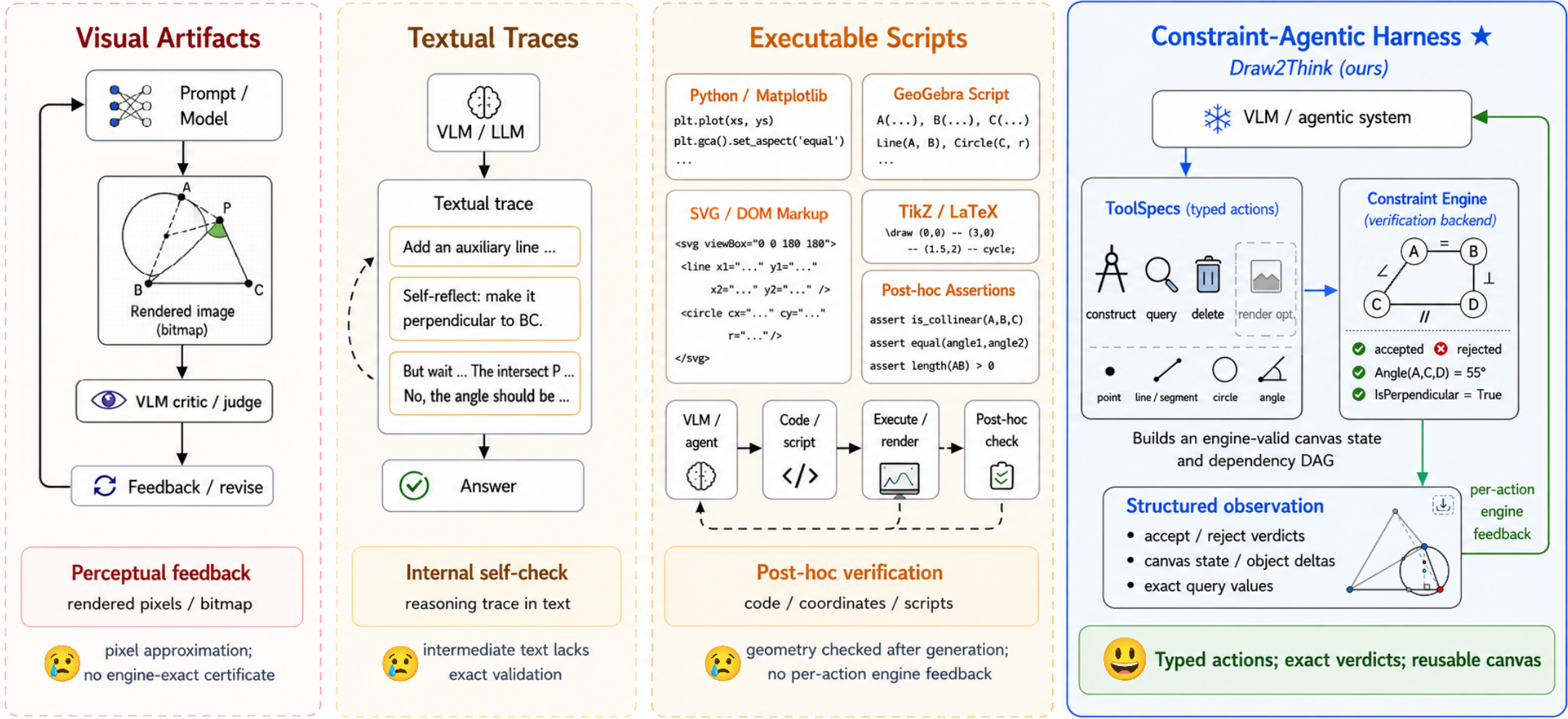
Comparison of four routes for externalizing intermediate state. Draw2Think's difference is the last one: verification happens immediately after each action, not once at the end.
02 The Problem It Actually Targets
The paper's starting point isn't "the model computed wrong" — it's a more precise description:
When reasoning, vision-language models treat angles, auxiliary lines, and length relations as subsequent premises, but these intermediate states may exist only in text or latent representations, never checked by any execution environment.
Note the keyword: latent.
Meaning: the model internally "believes" it constructed a perpendicular relation, but that relation never landed on any checkable carrier. It may be right, it may be wrong, and we have no means to distinguish.
The paper gives a real case (MathVista/290): the baseline model mistakenly treats two angles as equal, reasons through with alternate interior angles, and outputs 105°; after the construct-plus-measure loop, the reading is 75°.
One local misreading propagates down the whole reasoning chain. That's the seam the paper wants to cut into.

What the paper really targets isn't "the model can't do it" — it's that intermediate states have no external receipt.
03 Why Earlier Methods Fall Short
In Related Work the paper classifies routes and positions itself. One caveat is mandatory: this comparison is framed by the authors — it shouldn't be read directly as "old methods can't do precise checking."
| Route | Intermediate Representation & Feedback | Gap the Paper Identifies |
|---|---|---|
| Text / image CoT | Textual derivation, generated images, visual re-observation | Lacks constraint-level receipts; visual approximation ≠ mathematical relation holding |
| Drawing programs & rendering feedback | Code, modifiable figure state | Timing of checks and authority of return values are insufficient |
| Symbolic solving & formal reasoning | Axioms, predicates, derivations | Handles proof obligations, but differs in emphasis from "instance solving while constructing and reading" |
| Draw2Think | typed ToolSpecs → persistent canvas → object changes / values / errors | Wires execution, readout, and local recovery into the reasoning loop |
The paper's distinction between "pixel similarity" and "geometric correctness" is the basis of this comparison: a figure that looks close to 90° doesn't mean it satisfies the perpendicular constraint. A visually near-vertical line may actually be 89°.
There's a phrasing worth remembering here: constraint-first.
- Method 1: generate a visual result first, then hope it satisfies the geometric relation;
- Method 2: first declare "I want an object satisfying the perpendicular relation," then have the engine generate a result satisfying it.
This isn't "method 2 is more accurate" — it's that the order of commitment is reversed.
04 Core Method: Propose–Draw–Verify
The paper writes the entire geometry solution as a state-space search, not "calling a few tools."
The symbols aren't complicated; one by one:
- : current canvas state (which objects have been constructed, which relations hold);
- : the action at this step;
- : the engine executing this action;
- : the new canvas after execution;
- : reading the answer the problem asks for out of the final state .
What it emphasizes is really this: what step 2 can do depends on what step 1 has already established on the canvas. So what gets "searched" isn't an answer sentence — it's a geometric world state that can support a correct readout.
A concrete example, starting from an empty canvas:
S0 = empty
 → S1 = {A, B}
 → S2 = {A, B, segment AB}
 → S3 = {A, B, AB, perpendicular through A}
 → find intersection, read angle, give answer
The three roles divide like this:
Propose: VLM decides what to do next (choose tool u_k + fill parameters φ_k)
   ↓
Draw: GeoGebra executes the action, updates the canvas (S_k = T(S_{k-1}, a_k))
   ↓
Verify: the engine returns object changes, values, or errors to the model
The paper splits and writes this factorization:
Why is this split useful? Because it shows "knowing to draw a perpendicular" and "mistakenly passing a point object as a line parameter" are two different failures. Choosing the tool and filling parameters are two distinct difficulties — the former leans on natural-language description, the latter on type signatures and preconditions.
The paper also gives two engineering details, both about "whether it can actually run in practice":
- Tool catalog: 92 planar items = 55 construction + 24 query + 13 rendering; ordinary planar solving actually exposes 79, the 13 rendering tools are only used for GenExam, and 3D activates another 21 extensions;
- Persistent state: object dependencies form a DAG; deleting a parent object cascades to descendants. When a step fails, the action is rejected, but previously successful objects remain, so the model only needs to fix the current branch.
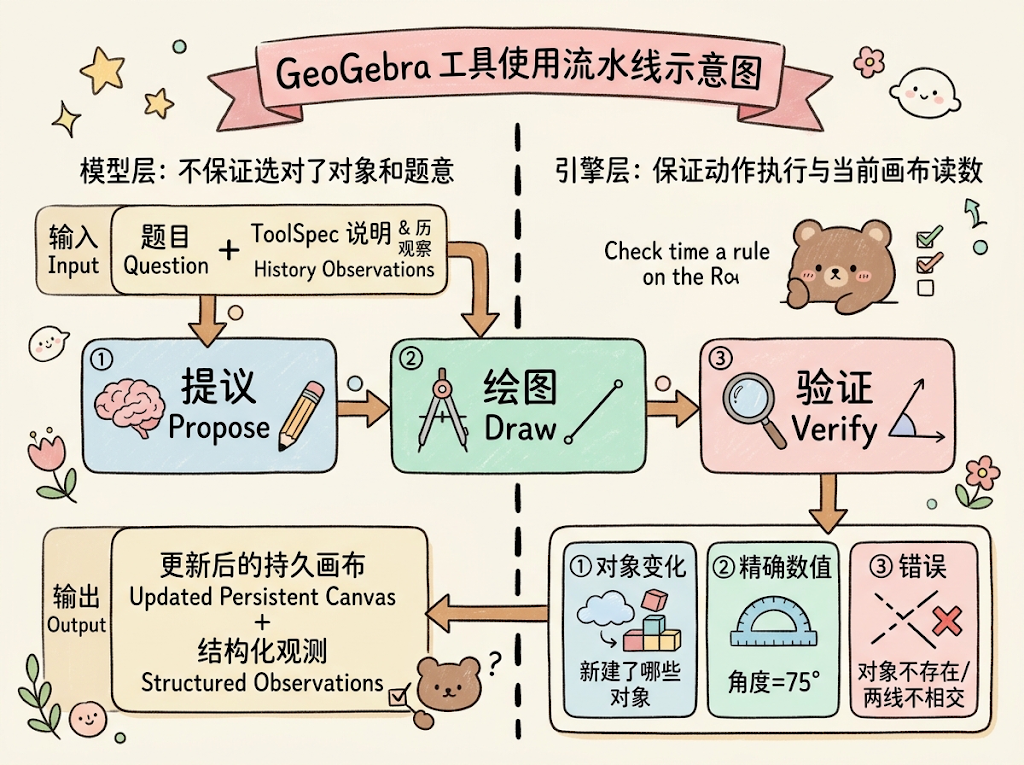
The PDV data flow. The line in the middle is the most important line in the whole paper: the engine will not cross it to judge the problem's intent for the model.
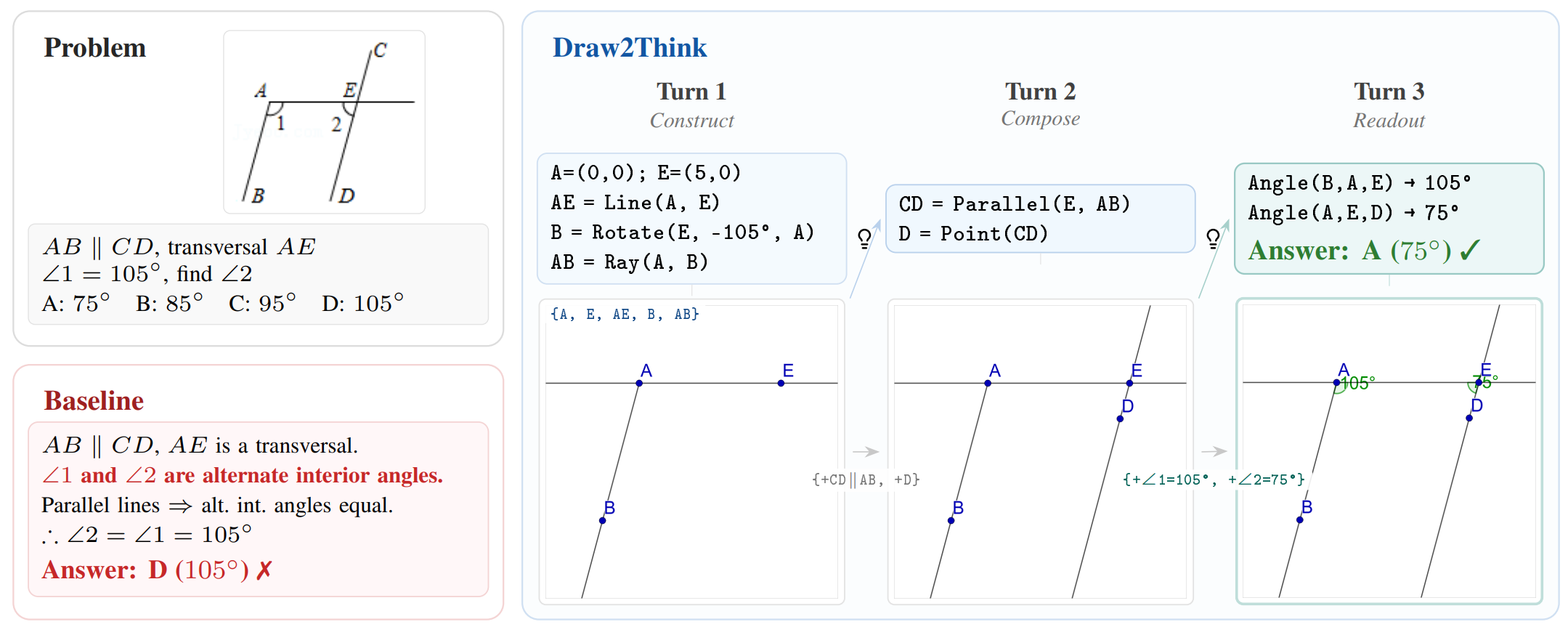
Same model, two reasoning modes. The difference isn't the model — it's whether intermediate states get checked by the engine.
05 The Most Important Boundary: Two Kinds of "Faithful"
This is the most easily misread and most worth taking away from the paper. It deliberately splits two concepts:
| Concept | Belongs to | Question Answered | Who Guarantees It |
|---|---|---|---|
| Construction Fidelity | Model-level property | Does the final canvas satisfy the geometric relations the problem requires? | Not guaranteed by the engine; needs offline audit |
| Measurement Faithfulness | Engine-level property | On this current canvas, are the returned values/relations faithful? | Automatically guaranteed by the engine |
Back to the opening example:
- Measurement Faithfulness ✅ Success. Because GeoGebra faithfully answered "in this (wrong) figure, what are the angles and lengths";
- Construction Fidelity ❌ Failure. Because the problem required
Perpendicular(A,B,C), but the model actually constructedPerpendicular(D,B,C)— the object relations don't match.
The key conclusion is one sentence: the engine can measure a wrongly built figure with perfect accuracy.
In the paper's own words: the engine guarantees "what can be derived from the current canvas," not "whether the current canvas matches the problem's intent."
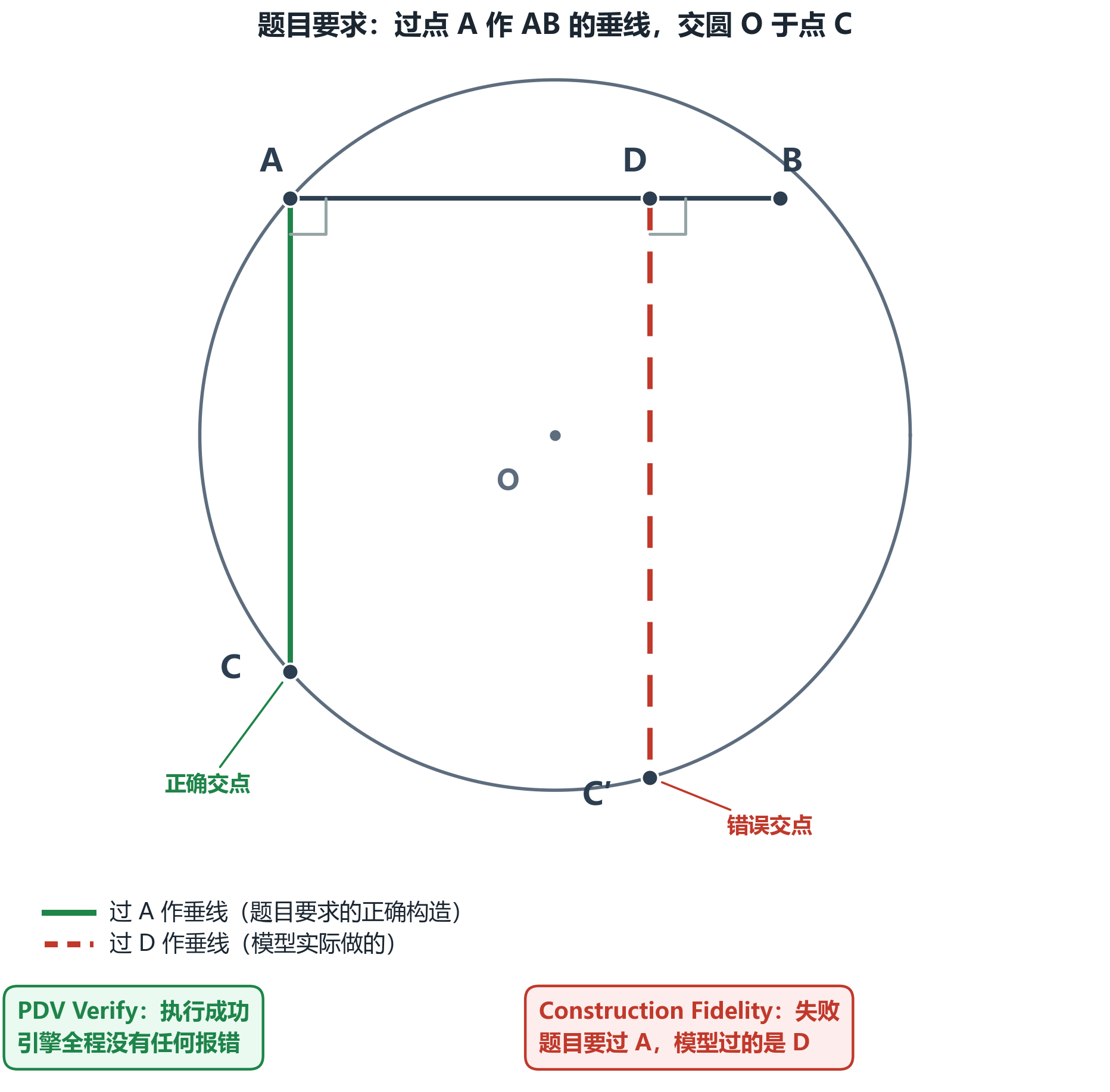
One legal canvas, two verdicts. GeoGebra never raised an error, because it has no idea you picked the wrong point.
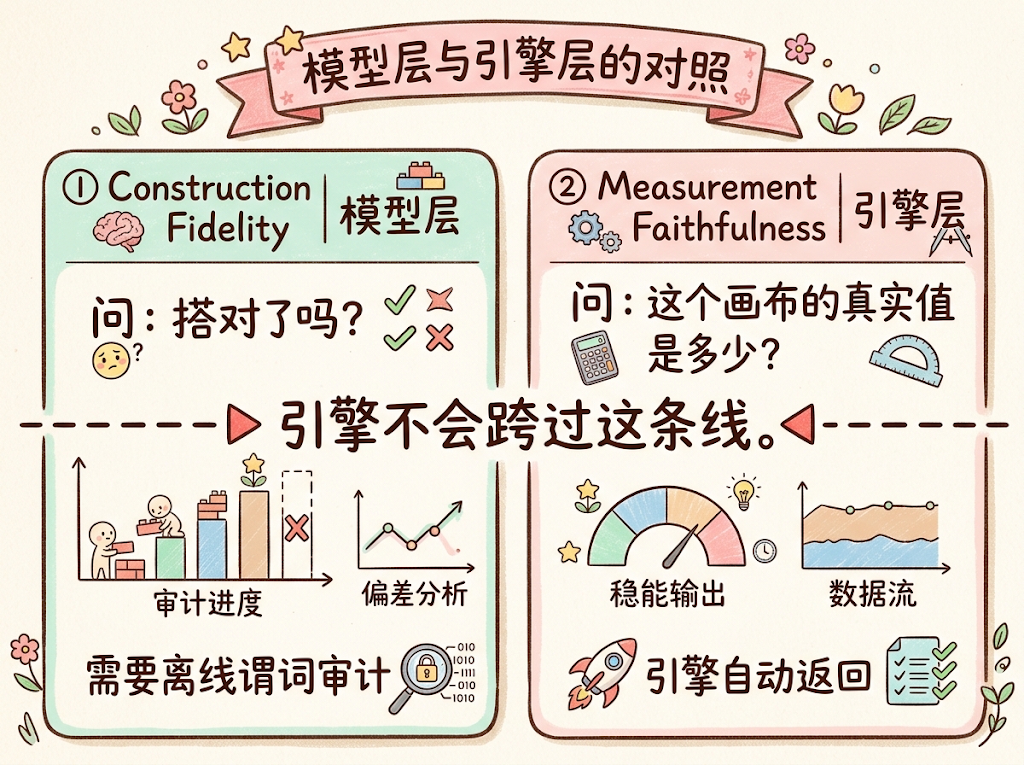
Remember this figure and you'll avoid 90% of over-interpretation about geometry agents.
06 So What Does Verify in PDV Actually Verify?
Continuing from the previous section, we must separate PDV's Verify from "verifying the problem's intent":
Verify:
"Did I correctly execute the action you asked me to do?"

Construction Fidelity:
"Was the action you asked me to do actually what the problem needed?"
PDV's Verify can tell you:
- whether the action is legal;
- what object was created;
- what the current measured value is;
- whether there was an execution error.
It cannot automatically judge:
- "Did you pick the wrong point?"
- "Is this auxiliary line actually what the problem needs?"
- "Does the whole canvas now fully match the problem's intent?"
This is also why the paper isolates Construction Fidelity into a separate offline audit, rather than claiming PDV has solved intent correctness.
The paper does one more thing here: it splits errors into two classes, because they need different fixes.
| Error Type | Meaning | After Loosening Tolerance |
|---|---|---|
| Structural error | The geometric relation itself is wrong, e.g. should be perpendicular but constructed parallel | No improvement — forms an essentially flat plateau |
| Numerical / precision error | Relation is right, but coordinates/float precision fail the threshold | Pass rate rises |
Quick quiz: an angle is theoretically 90°, the construction relation is correct, but the engine reads 89.9998° — which class is this?
The answer is the second. This distinction directly determines whether you should change the model strategy or the numerical handling.
07 Results: Not Uniform Improvement, but "Selective Gains"
The main experiment uses Gemini-3-Flash Preview, temperature=0, Pass@1, same problems and same model; BL is direct answering (single call), CT is closed-loop construction (up to 30 rounds, 120 seconds each).
The results are this set of numbers (unit %, differences in percentage points):
| Dataset / Setting | N | BL | CT | Diff |
|---|---|---|---|---|
| SolidGeo-hard Level 3 | 177 | 59.9 | 76.3 | +16.4 |
| MathVerse-solid | 119 | 82.4 | 88.2 | +5.8 |
| GeoSketch | 390 | 81.8 | 85.9 | +4.1 |
| MathVerse Plane | 510 | 87.5 | 91.0 | +3.5 |
| GeoQA / UniGeo calc test | 754 | 93.6 | 96.9 | +3.3 |
| GeoLaux | 221 | 93.2 | 94.1 | +0.9 |
| MathVista GPS | 208 | 97.1 | 97.6 | +0.5 |
| OlympiadBench | 112 | 89.3 | 89.3 | 0.0 |
| Geo3K | 601 | 98.2 | 95.3 | −2.9 |
| PGPS9K | 1,000 | 94.5 | 90.5 | −4.0 |
Both gains and losses — that's the most interesting part of this paper. The authors call it selective gains and give a mechanistic explanation:
- The big gains are on visually heavy problems requiring spatial construction (hard 3D, geometry sketches). Here the engine replaces expensive and unstable internal spatial simulation;
- The losses are on textbook-style benchmarks already near saturation. Here the baseline gets them right with cheap internal reasoning, and forcing a construct-query pass just adds decision points and failure opportunities.
There's a conclusion in the paper you can copy straight into your notes: External tools are not universally beneficial.
In engineering terms: more tools isn't better — they're valuable only when a bottleneck actually exists.
An applied judgment: a triangle with two angles 50° and 60°, find the third — that needs one mental computation of 180−50−60, not a canvas.
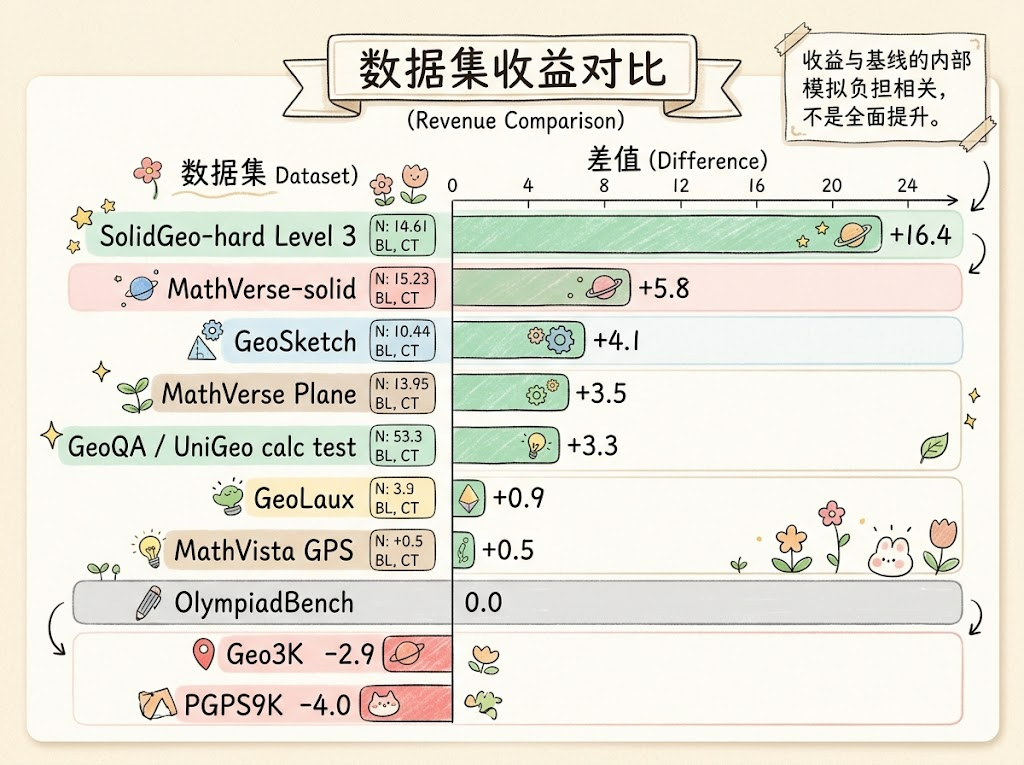
Same system, +16.4 on hard 3D and −4.0 on PGPS9K. A tool's value depends heavily on problem type.
08 GeoGoal: 95.94% vs 84%, and a 100% Trap
To independently audit "whether the model actually built it right," the paper uses GeoGoal: 256 problems, 13,254 geometric predicates, 7,395 query expressions. The evaluator looks only at the named-point coordinates of the final canvas — not the reasoning trace, not the final answer.
Three metrics must be kept apart:
- SR = 95.94%: predicate-level — what fraction of all predicates pass;
- SC = 84.0%: strict problem-level — all predicates of a problem must pass to count as success;
- CR = 100%: non-empty canvas rate — only requires that something was drawn.
High SR doesn't mean many problems were "fully constructed correctly." Extreme example: 100 problems, 10 predicates each, each problem wrong on exactly 1 — SR is 90%, SC is 0%.
CR = 100% is even easier to misread. It only says the model "successfully produced a non-empty canvas," not that the canvas matches the problem. As long as objects were drawn, CR is 100% even if every key constraint is missing.
Here's a set of numbers that says more. Split canvases into two groups by whether SC passed, and compare subsequent readout quality:
| Readout Match Threshold | SC Passed (n=215) | SC Failed (n=41) |
|---|---|---|
| All Ti exactly match | 31.2% | 0.0% |
| ≥90% Ti match | 83.7% | 7.3% |
| ≥80% Ti match | 94.4% | 22.0% |
Note how to read this table: it supports "construction passing correlates with readout quality," and incidentally proves something — SC passing isn't sufficient either, since strictly exact matches are only 31.2%.
The paper also runs a tolerance sweep that cleanly separates the two error classes: structural targets plateau stably at about 88% across five orders of magnitude (loosening tolerance doesn't help), while numerical targets climb from 51% at 1e−4 to 94% at 3e−2. This is the experimental evidence for the distinction in Section 06.
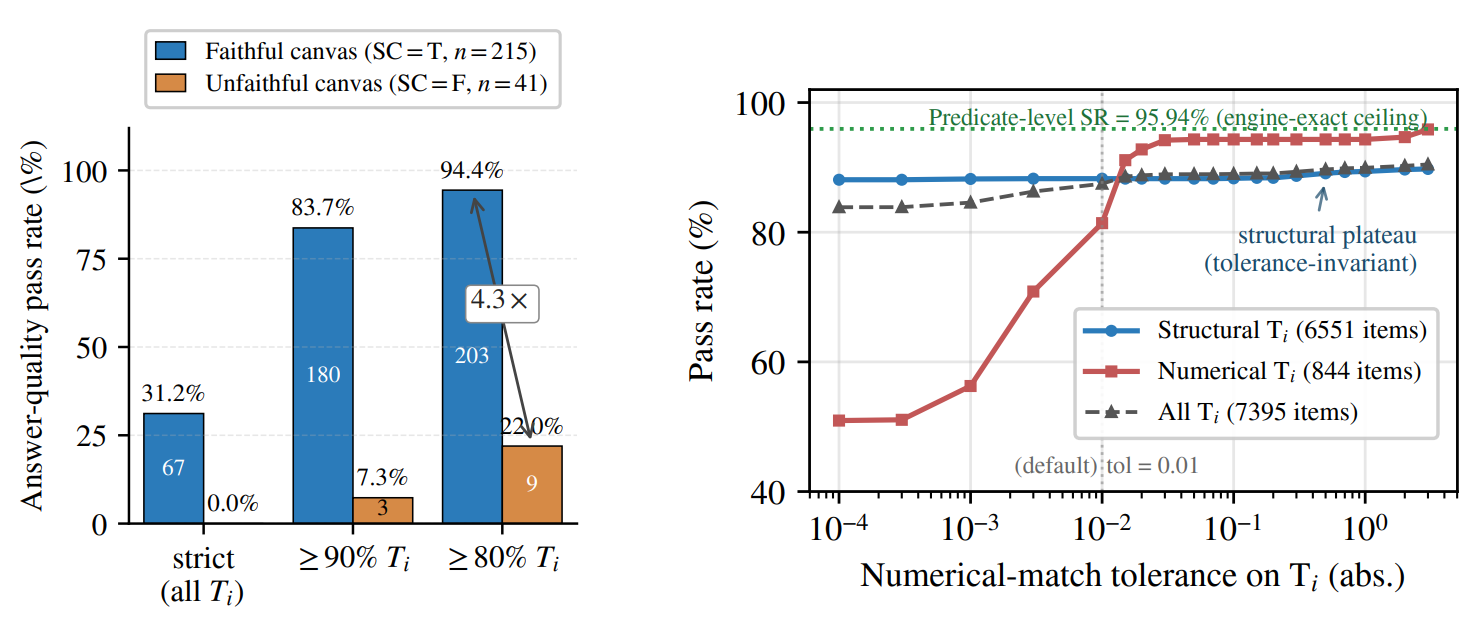
Left: canvases built correctly have noticeably better readout quality. Right: structural errors don't improve with looser tolerance, numerical errors do — the two failure classes need completely different fixes.
09 What the Paper Proves, and What It Doesn't
One of the paper's most valuable contributions is separating three kinds of "correct." These three layers can't be merged:
| Layer | Question Answered | Actual Evidence in the Paper |
|---|---|---|
| Execution & readout | Did the tool run on the current input and return a quantity of the current canvas? | Typed interface, engine returns, error logs; numeric tools and silently undefined degenerate objects still exist |
| Construction fidelity | Does the current canvas satisfy the relations the problem specifies? | GeoGoal's tolerance check on designated predicates; depends on the given construction text and a finite predicate set |
| Mathematical proof | For all configurations satisfying the premises, does the conclusion hold? | This paper is explicitly limited to numerical instances; it relies on the DAG being a proof-relevant trace, not a universal proof |
So the paper provides instance-level verification, not a universally quantified proof.
A very clean boundary statement:
Measuring AB ⊥ CD on some instance only shows "this holds for this specific submitted canvas state" — it doesn't follow that "all legal configurations satisfy it."
One more phrase that must be mentioned: "engine-exact" can't be stretched indefinitely. The paper's actual audit is float coordinates + tolerance checking (absolute tolerance 4×10⁻⁷ or relative 0.1%), and the tool catalog includes numerical solving. It can be read as "controlled execution and checkable readout relative to a given state," not as "all return values are mathematically error-free symbolic certificates."

Three layers of "correct" need three different verifiers. A green success marker can't replace them.
| Step | Tool Call | Deps | Used by | Geometric Interpretation | Semantic |
|---|---|---|---|---|---|
| 1 | add_point(A, 0, 0) | ∅ | Point existence | ||
| 2 | add_point(B, 4, 0) | ∅ | Point existence | ||
| 3 | add_segment(AB, A, B) | Two points segment | |||
| 4 | add_perp_line(L, A, AB) | Perpendicular through a point | |||
| 5 | add_circle(c, A, 3) | Center + radius circle | |||
| 6 | add_intersect(P, L, c, 1) | Line–circle intersection (1st) | |||
| 7 | query_distance(B, P) | — | Measurement readout |
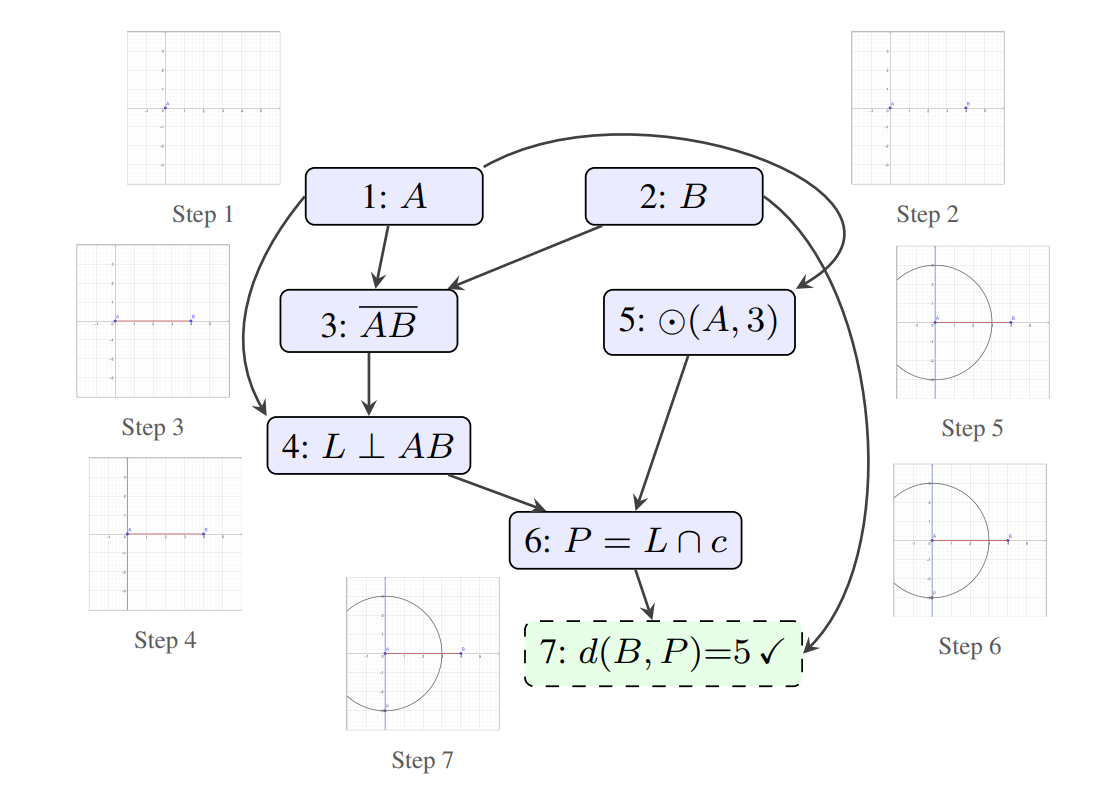
One figure to understand what "dependency" means: delete any node and every downstream object fails with it.
10 Limitations, Failure Cases, and What to Know Before Reproducing
The limitations the authors themselves admit are written fairly honestly:
- Step validity doesn't guarantee trajectory-strategy validity: long construction chains, ambiguity awareness, and missed relations still fail;
- Some problems don't need the engine at all: forced construction only adds overhead; deciding "when to call" must be left to the strategy layer;
- Only targets single numerical Euclidean instances: doesn't cover general quantified proofs;
- Narrow observation channel: mainly returns objects, deltas, and values — hard to detect layout or region-selection errors;
- Limited cross-model validation: transfer is only observed on 112 OlympiadBench problems.
Among the public failure cases, two are especially worth examining:
- Execution all correct, intent all wrong: in one problem, the first 3 of 7 rounds failed and were rejected, after which everything was error-free, yet the final legal canvas still missed 57% of GT predicates. This shows the residual burden is at the policy level, not the execution level;
- Query misalignment: the model queried an irrelevant quantity, eventually worked its way to the answer, and appears to have "used the engine," but the answer wasn't directly mediated by a readout.
The paper also records a detail: failed calls mainly come from the model layer (referencing nonexistent objects, intersecting when preconditions aren't met, passing degenerate objects, parameter type errors), and about 5% of failed calls involve degenerate inputs that may silently produce undefined objects.
If you want to reproduce, know three things:
- Three different evaluation pipelines, don't mix them: ordinary solving (answer accuracy), GeoGoal (construction fidelity — the model submits only a canvas, no answer), GenExam (outputs images, one extra rendering layer);
- The data wasn't used for training. This is inference-time evaluation: existing benchmarks → frozen VLM → GeoGebra interaction → answer/canvas/image → evaluation;
- training-free ≠ no engineering investment. The tool table was drafted with LLM assistance and refined over roughly eight rounds using trial-run failures; what the model sees includes purpose, parameter types, preconditions, naming, and angle-direction rules.
Minor blemishes found while close-reading (written out so you know to be careful when reproducing): MathVista's correct-problem count appears as both 203/208 and 204/208 across tables in the paper; the drawing-failure attribution table's category counts (17+14+4+5=40) don't cover the 48 failures in its title. These don't affect the main conclusions, but exact reproduction needs a consistent per-problem log.
11 Takeaways for Ordinary Developers, Researchers, and Interviewees
For people building agents: the most transferable lesson isn't "hook up a tool" — it's:
Design the intermediate workspace as executable objects, not just a stored explanation.
Its value depends on two things: whether the workspace checks the constraints that actually matter, and whether the check results enter decisions promptly.
For people doing evaluation: three things you can borrow directly.
- Answer accuracy conflates "actually reasoned it out," "text shortcut," and "got lucky" — so you need process metrics;
- Ablations should be designed by functional channel. In the paper, the "no query" group can still obtain the same values through
add_*return values — deleting the function name isn't deleting the information; - Net benefit must count both Saves and Breaks. Across eight planar settings, total N=3796, Save=133, Break=128, for a net gain of only 5 problems (about +0.132 percentage points). Showing only "rescued cases" hides problems "originally correct but broken by the tool."
For interviewees: if asked about "tool calling / agent memory and feedback," this paper gives a good answer skeleton:
First, leave the high-uncertainty "propose the next step" to the model, and give the deterministic "execute and verify" to the engine; Second, distinguish "the action was executed" from "the action was what the problem needed"; Third, distinguish instance-level verification from formal proof — don't call a tool's success marker a mathematical proof.
For researchers: the biggest gap this paper leaves is one sentence —
step-level verification ≠ strategy-level reasoning.
GeoGebra will only tell you "I successfully drew this perpendicular." It won't tell you "you didn't need to draw this perpendicular at all."
The paper itself admits: the current canvas is mainly exposed to the model as flat JSON, and DAG topology isn't yet used as a full planning input — this is written into future work.

The paper solved "is this step executed correctly," not "should this step be done at all." That's also the real entry point for the next research step.
12 Summary
- Draw2Think's core isn't "making VLMs draw geometry" — it's turning the intermediate state in geometric reasoning into an executable, measurable, revisable constraint workspace;
- It solves step-level grounding: whether an action was executed, and what the true values of the current canvas are;
- It doesn't solve strategy-level reasoning, nor formal proof: intent understanding, whether the whole strategy is reasonable, and whether conclusions hold universally remain separate problems.
The line most worth taking away is still the opening example:
The engine can measure a wrongly built figure with perfect accuracy. Its guarantee stops at the canvas — it doesn't cross over to intent.
References
- Draw2Think: Harnessing Geometry Reasoning through Constraint Engine Interaction — https://arxiv.org/abs/2605.20743
- Project page: https://draw2think.github.io/
- Code repository harness-geometry: https://github.com/draw2think/harness-geometry
- Newclid (symbolic solver; this paper uses its
check_numerical()for predicate checking): https://arxiv.org/abs/2411.11938 - GeoGebra
Provecommand docs (distinguishing current-coordinate judgment from general symbolic judgment): https://geogebra.github.io/docs/manual/en/commands/Prove/ - GeoGebra
NSolvecommand docs (numerical solving): https://geogebra.github.io/docs/manual/en/commands/NSolve/ - MathCanvas: https://arxiv.org/abs/2510.14958
Copyright Ownership: Kstheme, Contributors: Kstheme
Copyright
Copyright Ownership:
License under: